Row boats: why row backward?
Rowing a boat is great
exercise. And it's a powerful and efficient
way to propel a boat.
But the fact that it's done facing backward
and you have to twist around to see where you are going... well... a lot
of people are just not going to do that. At least not for
fun.
But
wait a minute.
Rowing doesn’t need to be done facing backward. There are
alternatives.
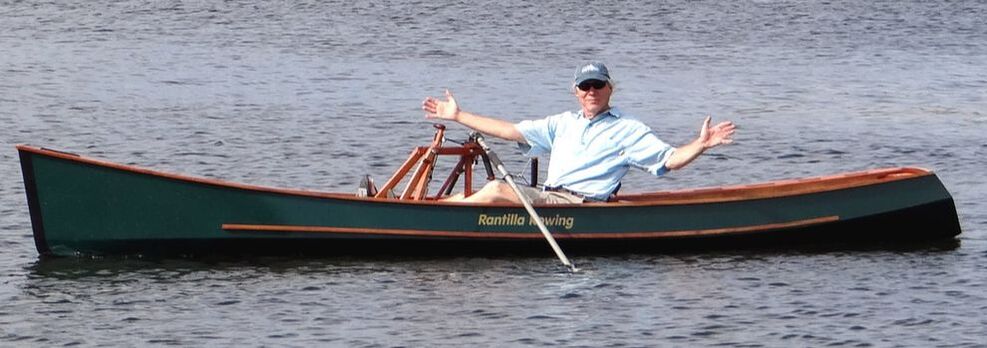
With our system, you row facing forward.
The exercise quality is as good as conventional rear-facing sliding-seat rowing,
but with less stress on your back and wrists. And it's just as powerful and even more efficient. Plus you can row it
hands free, so you can use
your hands for photography, bird watching or fishing while rowing and
steering with your feet.
The FrontRower™
Rowing System
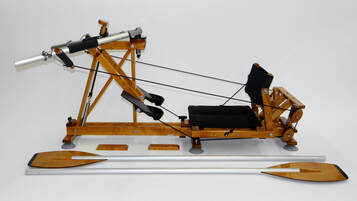
The FrontRower™ system is
based on an unconventional type of oar having the oarlock on the
end rather than in the middle of the oar. This moves
your boat in the direction you are facing when you pull on the handle (in
the same way that paddling does).

The FrontRower™ has many
other features giving you the following advantages:
-
You travel forward, so you
can see where you are going.
-
You can use your arms and
legs, so you can generate lots of power and get good exercise.
-
It uses moving pedals to
develop leg power more efficiently than a sliding seat.
-
You can row it hands free—for
photography, bird watching, fishing or just plain ease of use.
-
It has a big comfortable
seat with a backrest.
-
It's easy to use—the oars
lift, dip, and feather automatically.
-
It has ergonomically correct
handles which reduce stress on wrists and elbows.
More about the FrontRower™
A few things you should
know about row boats

Skiff.
The wide flat bottom on this boat makes it stable but hard to move in
the water. This is a work boat, not intended for enjoyable rowing.
On a boat this beamy, the oarlocks are usually mounted
on the gunwales. The fixed seat does not give the benefit of leg power.
It has a rear facing
position when pulling on the oars.

Shell.
Fast but not stable. Intended for speed rather than enjoyment. If you
let go of the oars, you will probably tip over. Conforms to the
rules of competitive rowing, with oarlocks mounted on outriggers, a sliding seat for
leg power, and the standard rear facing position.

Recreational Canoe.
Moves easily through the water and is reasonably stable.
Most tandem recreational canoes can be fitted out with the FrontRower forward
facing rowing system (you'll have to remove the center carry thwart).
One person rowing can move as fast as (or even faster than) two paddlers
and with better control.
A touring rowboat is
a boat that's
intended for enjoyment of the rowing outing itself. It will have comfort
and ease of use as primary design considerations. It will be
fast enough to be fun and stable enough to stay upright without effort.
Touring rowboats for one or two occupants tend to be about the same size
and shape as tandem recreational canoes.
For exercise rowing
you do not need a racing style shell. You can get the same quality
exercise in a touring boat. However, the touring boat will be more
comfortable and easier to use. And if it's forward facing and allows
you to use your hands to hold a camera or fishing rod it can be very
enjoyable—meaning you will look forward to using it more often.
Our Odyssey wooden row boats are designed specifically
for the FrontRower™. They are among the best touring rowboats
available and are easy to build from kits or plans.
More on boats for the
FrontRower™
|
*Two alternatives
to backward rowing have been around for a long time: (1) push rowing and
(2) articulated oars (two piece oars with a joint in the middle). However,
neither of these methods gives you the exercise quality and the performance
of conventional sliding seat rowing. The FrontRower™
does.
Conventional oars are oars which have the oarlock in the middle
(between the handle and the blade). It's conventional because
it's the most common type in use. Conventional oars will move the
blade in the opposite direction of the handle. This means you travel
backward when pulling on the handle.
The
rules of rowing. The sport of competitive rowing has rules.
These rules require rowers to face backward. They also disallow any
method of developing leg power other than a sliding seat, which is not
very efficient. (But if you're not racing, you don't need to follow these
rules.)
|
|